
What is Compost?

What is compost? Compost is decomposed organic material that can be added to soil to help plants grow. It includes food scraps, yard waste, and even shredded paper, cardboard and matches.
Why is it important to compost? Food scraps and yard waste make up ~30% of what we throw away and nearly half of the food in the US is thrown away.
When organic material is sent to the landfill, it decomposes anaerobically (without oxygen) because it’s buried deep below other garbage. This keeps it from decomposing at a natural rate.
Without the help of oxygen and pests, it releases an abundance of carbon dioxide and methane into the atmosphere.
Landfills are the third largest source of human-related methane emissions in the US — a lot of that coming from food waste. Methane is 28-30% more effective than CO2 at trapping heat in the atmosphere.

If you’re like me and don’t have a yard or garden where you can keep your compost, you can collect food scraps in your kitchen and do a few things with them:
Donate to a community garden in your area (a quick google search usually does the trick)
Check to see if your city offers curbside compost pick-up. Some have their own compost bins and some placed allow food scraps in the green yard waste bin (like LA).
Check your local farmers market once it’s safe. Many include community compost drop-off.
There’s also a really neat machine called the @foodcycler that I stumbled upon doing research that turns food scraps into soil inside the house. I’d love to try one of these out!

What can you put in your home compost?
Green items:
Fruit scraps
Vegetable scraps
Coffee grounds
Coffee filters (unbleached)
Egg shells (shell only)
Green leaves
Grass trimmings
Old Flowers
Brown items:
Mulch/wood chips
Dead leaves
Sawdust (from untreated wood)
Twigs (break into 2-3” pieces)
Newspaper
Shredded paper
Unbleached cardboard (torn into small pieces)
What NOT to put in home compost:
No meat
No dairy
No pet poops
No cat litter
No compostable plastic
No infested plants

Here’s a roundup of some countertop compost bins if you’re in the market! Ours is on the top left and it’s made from bamboo.
Wood Countertop Compost Bin (etsy)
Stainless Steel Compost Bin (william sonoma, amazon)
Oxo Compost Bin (sur la table, amazon)
Hammered Copper Compost Bin (gardener’s supply company)
Ceramic Compost Pail (pottery barn)
Foodcycler (no food waste)
Do you own a compost bin? I’d love to know what you have and how much you love it!
Zero Waste Dryer Sheets DYI

Dryer sheets and fabric softeners are full of chemicals (and can actually damage clothing, depending on the fabric). Did you know that vinegar acts as a natural fabric softener without leaving any chemicals + residue on your clothing?
I’ve taken some old unpaper towels that were at the end of their life and cut them up to make my own natural + sustainable dryer sheets. Here’s how to do it!
What you need:
-any old rags or fabric you have laying around
-white vinegar
-essential oils of your choice OR white vinegar that has been diffused with natural scents.
How to do it:
1. Put your old rags and fabric in a jar.
2. Mix about 10-15 drops of the essential oil you’d like to use with about a cup of vinegar. You can also diffuse the vinegar ahead of time with discarded citrus peels, rosemary, lavender, or pine needs leftover from your Christmas tree (that’s what I did here).
3. Pour the scented vinegar over the rags in the jar until they’re moistened, but not totally soaking in liquid.
4. Use one of the cloths per load of laundry.
5. You can throw the rags into the wash once they’ve been used and re-soak them to keep using again and again.
I'll Have My Tea Without a Side of Microplastics, Please.
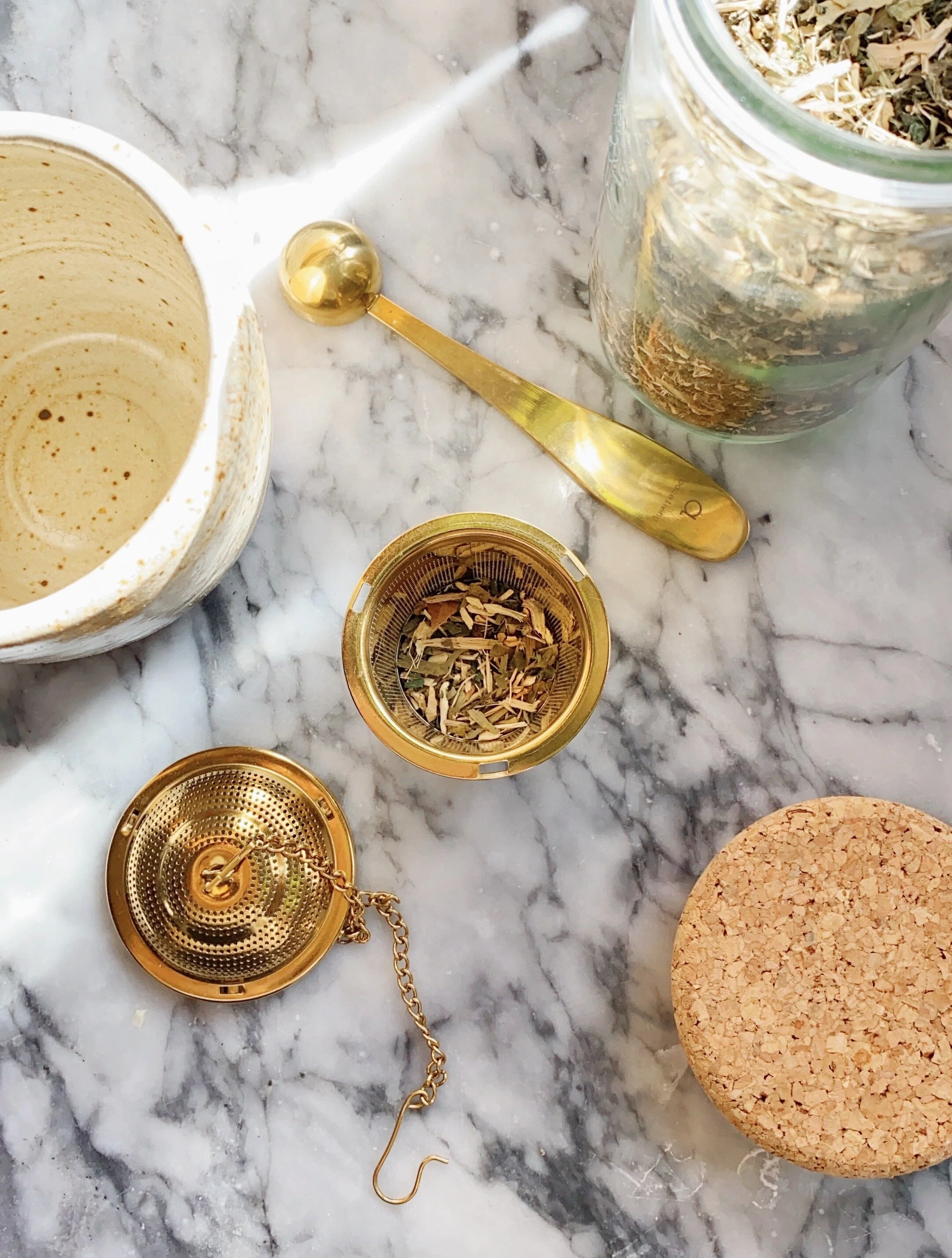
A study found that 11.6 billion microplastic particles are released when one tea bag is steeped in water (and on top of that, 3.1 billion even smaller nano plastic particles are released into the cup). That’s thousands of times higher than the amount of plastic previous found in other food + drink items. (cnn)
Even a lot of premium teas that use all natural fibers in their teabags often use polypropylene to seal the bags.
There currently aren’t any in-depth studies that show how the consumption of microplastics affect our health, so I’m going to play it on the safe side and try to consume the smallest amount I can… at least when I drink tea.
I’ve been using a stainless steel tea strainer that my mom gave me and it’s kind of like putting a little spaceship in your mug. I love it. I’ve dropped some of my favorites below:

Botra Teapot | Gold Stainless Steel Tea Egg | Brass Stem Tea Strainer ( I like to call this one the Golden Snitch) | Wooden Tea Press | Solid Brass Tea Strainer (reminds me of Flight of the Navigator for some reason)
The one in the top photo is one that was given to me by my mom for Christmas. Linking it here.
Do you have one that you use and love? I’d love to add more to my list of tea strainers! Most of the ones I picked look like they’re from an alien world or straight out of Harry Potter, which I am more than OK with.